Charles Mayo
The WhaleCharles Mayo, known as Stormy, is a Cape Cod conservationist whose life connects generations of whaling history with the effort to protect whales. After seeing a right whale as a teenager, he helped establish a research center, gathered data on the endangered animals, and became the first person licensed by the government to rescue whales caught in fishing gear. In his work, techniques once used to restrain whales are repurposed to save them.
Family and Cape Cod Background
Mayo was in his sixties when the book describes him. His father’s family had lived on Cape Cod for nearly four hundred years, tracing its arrival to Chatham in 1650; his grandmother came from Faial in the Azores. These family ties place him within a coastal community shaped by both local history and migration across the Atlantic.
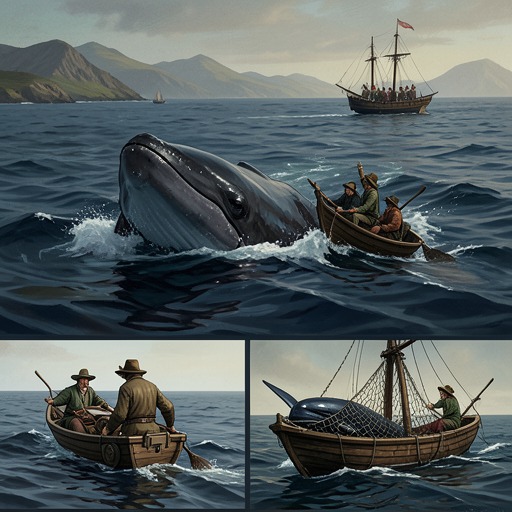
Whaling was part of that inheritance, but not an unbroken family vocation. Mayo’s grandfather hunted blackfish until he took a mother and heard her calf calling beneath his boat. After that experience, he could no longer continue whaling. He also told Mayo about a whaling station at Eastern Harbor, on the narrow stretch of land where the sea might have broken through and made Provincetown an island. The family story carries both the history of hunting and an early instance of its emotional cost.
Mayo’s connection to the region also took the form of discovery. While walking with his son Josiah, he found a hollow in the dunes where shifting sand had exposed a jumble of whale jawbones and vertebrae. The remains suggested a buried record of the animals that had once been numerous along the Cape, though the idea that the site was a place where whales went to die remained a possibility rather than an established explanation.
From First Sighting to Conservation Work
Mayo saw his first right whale at sixteen, while fishing with his father on Stellwagen Bank. The animals were already close to extinction, and although people knew some survived, their locations were largely unknown. That encounter developed into a lasting interest. In 1976, Mayo helped found the Provincetown Center for Coastal Studies and began collecting data on right whales.
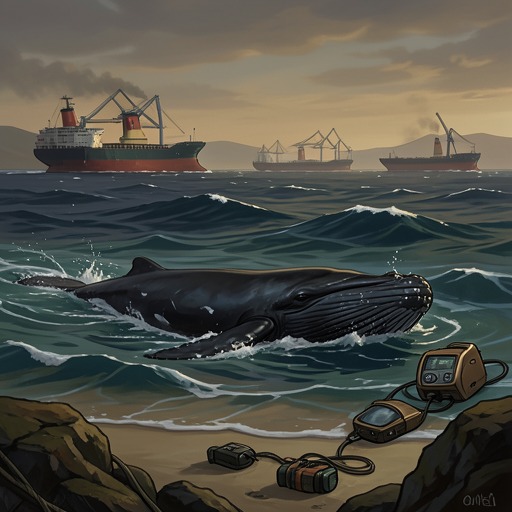
His research and rescue work addressed threats that persisted after hunting protections had been introduced. More than sixty per cent of right whales had been caught in fishing line, and ship strikes were also killing animals, including females of calf-bearing age. With so few breeding whales, saving even one fertile female could affect whether the population survived. Mayo’s work therefore joined close study of individual animals to the larger problem of a species at risk.
He became the first person licensed by the government to rescue entangled whales. The work could require Mayo and his colleagues to travel at short notice for costly operations. The account presents them as a new kind of whaling hero: people who go out to meet a whale not to kill it, but to free it from a human-made danger.
Rescue Methods and Their Reversal
When an entangled whale is reported, the Ibis reaches the scene as quickly as possible. The immediate danger is that the animal may drown; starvation or infection can also follow. Rescuers approach in a rigid inflatable boat and attach sea anchors to slow the whale. The method recalls the wooden kegs used by whalers and the inflated sealskins Native Americans attached to harpooned whales: equipment once used to control a hunted animal now helps make a rescue possible.
Mayo wears a helmet fitted with a video camera and an ice hockey mask while attempting to cut away the line. Instead of a barbed spear, he uses a long-handled hook to slice through the tangled gear. The resemblance to a Victorian harpooner is striking, but the purpose has changed. The rescue retains the risks and physical proximity of the old pursuit while reversing its intended outcome.
Mayo’s work does not make whales harmless or predictable. An angry, entangled animal can be dangerous, and recordings of rescue attempts show the force with which a whale can twist and thrash. His role demands that conservation be practiced in the presence of powerful animals, not merely argued for at a distance.
Significance
Mayo’s personal and professional history traces a shift in the human relationship with whales. His grandfather’s decision to stop hunting after hearing a calf, Mayo’s first encounter with a right whale, and his later rescue work mark different responses to the same animals. The family’s whaling past remains visible in the methods rescuers use, but those methods are now directed toward protection.
The sea around the Cape is not simply a backdrop to this change. It is the habitat through which whales migrate and the working space where fishing gear and shipping create hazards. Mayo’s research and rescues bring those conditions into view, making conservation a practical response to the history and ongoing pressures of human use of the ocean.